


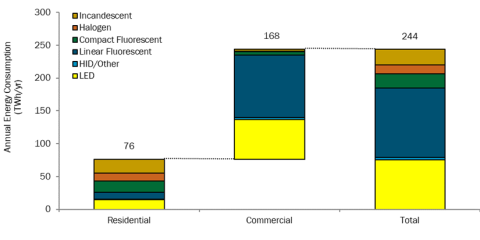
By publishing summary estimates of installed stock and energy use of various general illumination lighting products, these reports help DOE and others plan effective lighting research and development programs based on changing needs.
Today, BTO announced its Building Energy Efficiency Frontiers & Innovation Technologies (BENEFIT) 2024 Funding Opportunity (DE-FOA-0003158).
The U.S. Department of Energy (DOE) has published the first round of CALiPER test results for germicidal ultraviolet (GUV) products. The results highlight both substantial energy efficiency opportunities and efforts that are needed to address performance
The COVID-19 pandemic has put a spotlight on germicidal ultraviolet (GUV) radiation for air and surface disinfection. This technology area represents a growing opportunity to improve indoor air quality while saving energy over high-ventilation approaches.
The report examines high-priority opportunities to develop manufacturing technologies that will benefit energy-saving solid-state lighting (SSL) while also supporting an increased role in the global marketplace for U.S. manufacturing of lighting products.
DOE announced nearly $83 million in funding to 44 projects that will lower Americans’ energy bills by funding new energy-efficient building technologies, construction practices, and the U.S. buildings-sector workforce.
DOE has released a report, Changes in SSL Device Efficiency and Optical Performance with Aging: Final Report, focusing on the long-term changes in light source, optical delivery, and spectral efficiencies that occur as SSL device age.
The U.S. Department of Energy (DOE) has published a new report that characterizes the global manufacturing supply chain for light-emitting diodes (LEDs) and LED lighting products.
The prevalence of LED lighting has brought greater attention to the issue of discomfort produced by glare. At what luminance does glare become intolerable? The answer has varied from one study to another.
The performance of LED lighting is known to change over time because of lumen depreciation, shifts in chromaticity, and changes in the drivers.