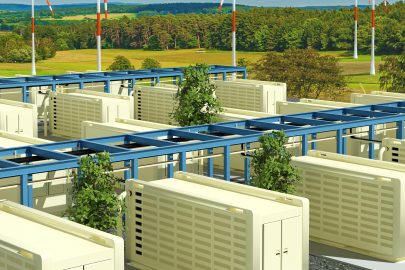
One of the distinctive characteristics of the electric power sector is that the amount of electricity that can be generated is relatively fixed over short periods of time, although demand for electricity fluctuates throughout the day. Developing technology to store electrical energy so it can be available to meet demand whenever needed would represent a major breakthrough in electricity distribution. Helping to try and meet this goal, electricity storage devices can manage the amount of power required to supply customers at times when need is greatest, which is during peak load. These devices can also help make renewable energy, whose power output cannot be controlled by grid operators, smooth and dispatchable.
They can also balance microgrids to achieve a good match between generation and load. Storage devices can provide frequency regulation to maintain the balance between the network's load and power generated, and they can achieve a more reliable power supply for high tech industrial facilities. Thus, energy storage and power electronics hold substantial promise for transforming the electric power industry.
High voltage power electronics, such as switches, inverters, and controllers, allow electric power to be precisely and rapidly controlled to support long distance transmission. This capability will allow the system to respond effectively to disturbances and to operate more efficiently, thereby reducing the need for additional infrastructure. A major challenge being addressed by DOE is to reduce the cost of energy storage technology and power electronics and to accelerate market acceptance.
OE's Energy Storage Program
As energy storage technology may be applied to a number of areas that differ in power and energy requirements, OE's Energy Storage Program performs research and development on a wide variety of storage technologies. This broad technology base includes batteries (both conventional and advanced), electrochemical capacitors, flywheels, power electronics, control systems, and software tools for storage optimization and sizing. The Energy Storage Program works closely with industry partners, and many of its projects are highly cost-shared.
The Program also collaborates with utilities and State energy organizations such as the California Energy Commission, Massachusetts Clean Energy Center (MASS CEC), Oregon DOE, Vermont, Hawaii, Washington, and New York State Energy Research and Development Authority (NYSERDA), to name a few, to design, procure, install, and commission major pioneering storage installations that are up to several megawatts in size. It also supports analytical studies on the technical and economic performance of storage technologies as well as technical evaluations of both ES systems components and operating systems. Enhanced energy storage can provide multiple benefits to both the power industry and its customers. Among these benefits are:
- Improved power quality and the reliable delivery of electricity to customers;
- Improved stability and reliability of transmission and distribution systems;
- Increased use of existing equipment, thereby deferring or eliminating costly upgrades;
- Improved availability and increased market value of distributed generation sources;
- Improved value of renewable energy generation; and
- Cost reductions through capacity and transmission payment deferral.
The Energy Storage Program also seeks to improve energy storage density by conducting research into advanced electrolytes for flow batteries, development of low temperature Na batteries, along with and nano-structured electrodes with improved electrochemical properties. In Power Electronics, research into new high-voltage, high power, high frequency, wide-band-gap materials such as silicon-carbide and gallium-nitride is underway. In addition, advanced power conversion systems using advanced magnetics, high voltage capacitors, packaging and advanced controls to significantly increase power density and performance is ongoing.