


Geothermal heating and cooling technologies, including networked geothermal, direct use, and geothermal heat pumps (GHPs), offer efficient temperature control solutions for buildings, campuses, military bases, and even entire communities. Widespread adoption of these technologies can help to reduce energy costs for families, stabilize the grid, and boost energy security.
Geothermal Heat Pumps
Geothermal heat pumps (GHPs), also known as ground-source heat pumps (GSHPs), take advantage of constant underground temperatures to efficiently exchange temperatures, heating homes in the winter and cooling homes in the summer. Using the constant temperature of the shallow earth (40–70°F), rocks and soils in the subsurface below a building or community can act as a heat sink—absorbing excess heat during summer, when surface temperatures are relatively higher—and as a heat source during the winter, when surface temperatures are lower.
Learn more about GHPs:
- Fact Sheet: Geothermal Heat Pumps Explained
- GHP Case Studies
- GHP PATHs Prize
- GHP Incentives and Technical Assistance
Networked Geothermal

Networked geothermal systems—sometimes referred to as Thermal Energy Networks (TENs) or district-scale— are geothermal systems that serve entire neighborhoods, city blocks, campuses, and communities. Rather than powering one building at a time, these systems provide heating and/or cooling to multiple homes or businesses together in a network. These systems can comprise networked GHPs as well as other technologies, and various kinds of configurations of these systems are emerging in universities and communities all over the United States.
Learn more about the Office of Geothermal's District-Scale Geothermal Energy Pilots initiative, research on geothermal low temperature and coproduced resources, and other Office of Geothermal priorities.
Geothermal Direct Use
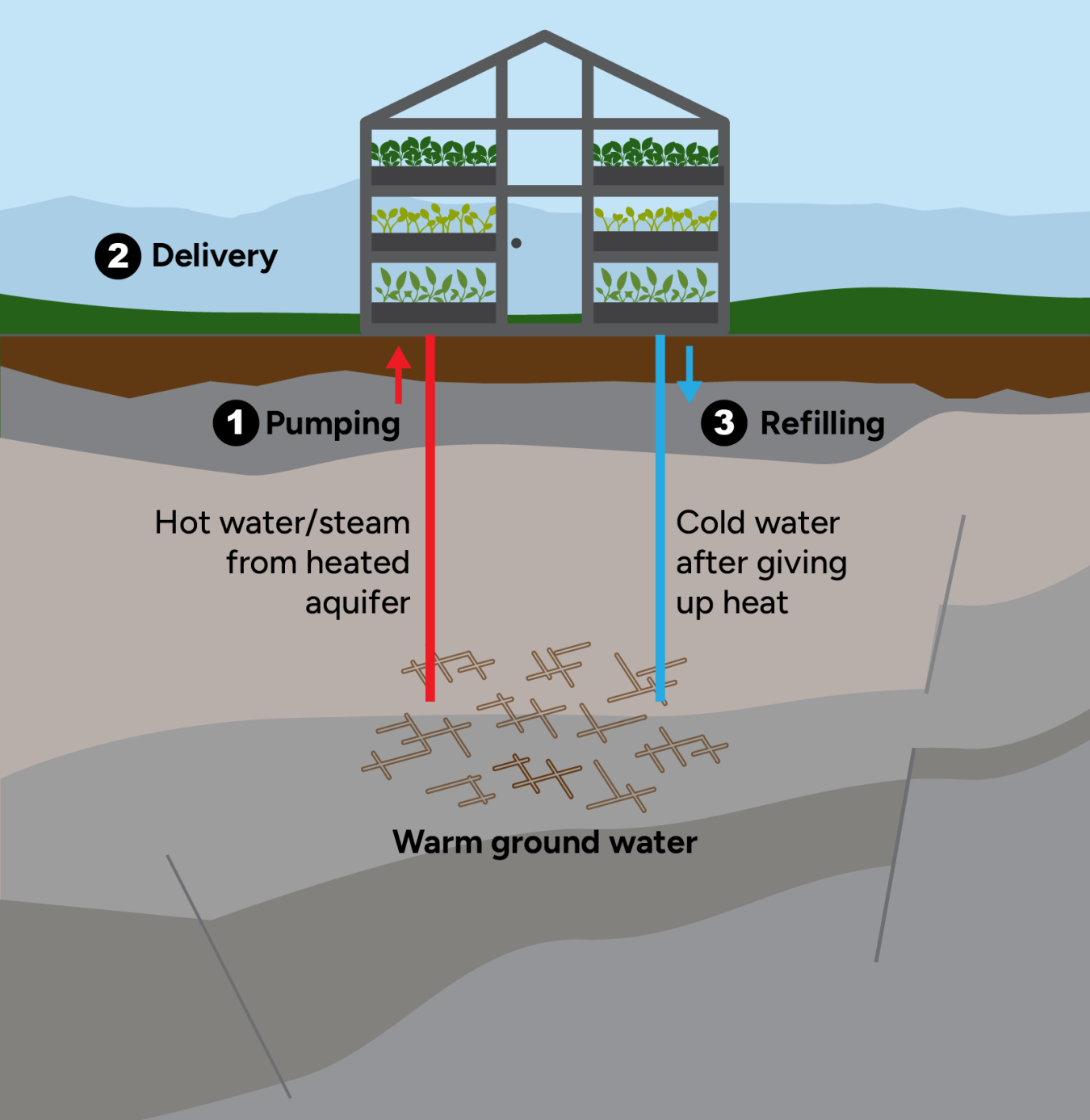
Geothermal direct use employs geothermal energy directly for heating or other applications, without first converting it to electricity. Direct-use applications tap into lower subsurface temperatures to draw up thermal energy that can be used to heat buildings or support industrial uses ranging from fish farming, to greenhouses, to food processing.
Learn more about the Office of Geothermal’s work in direct use research, including advances in deep direct use (DDU).
Geothermal Energy Storage
Underground thermal energy storage (UTES) is a geothermal technology where thermal energy, or heat energy, is stored in the subsurface to be extracted later for beneficial uses, including heating and cooling. UTES can be incorporated in TENs and direct-use applications or serve as a standalone system, and its benefits include low operating costs, compatibility with multiple heat sources, and the ability to help shift heating and cooling demand away from peak demands periods for the grid.
Examples of UTES Configurations:

Office of Geothermal emails bring funding opportunities, events, publications, & activities directly to your inbox.